
Skip to content
Start of page content below the header
News Story
29 October 2025

Unlocking the power of moringa

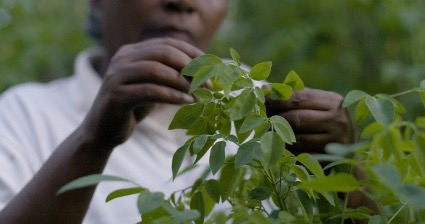
A farmer in Ethiopia harvesting fresh moringa leaves. Photo credit: Eshika Productions

Did you know that a single tree could help combat malnutrition, purify water, and restore degraded land? Moringa, often called the miracle tree,  holds immense promise for addressing nutritional, medicinal, and economic challenges. Native to India and sub-Saharan Africa, it thrives in dry conditions, is packed with essential nutrients, and offers countless applications. Yet, despite its well-documented benefits, moringa remains underutilized in research, markets, and policy frameworks.

The tree of life in everyday hands

Moringa, often called the Tree of Life,  looks humble, but its slender leaves, long pods, and tiny seeds carry a treasure of nutrition and healing potential that communities have relied on for centuries. Its gifts are simple to harvest and deeply rooted in tradition. The tender leaves can be plucked fresh and added to salads or boiled lightly to preserve their vitamins before being eaten as a vegetable stew. In some regions, the leaves are sun-dried and ground into a fine powder, making it easy to stir into soups, teas, or even bread dough, perfect for boosting nourishment in everyday meals. The pods, often called drumsticks, are cooked into curries, while the dry seeds yield an oil that is not only food-grade but also valued in skincare. Even the remaining seed cake holds power: it’s used in water purification, clarifying muddy water into something drinkable.

By embracing these simple preparation methods, each part of the tree offers nourishment: iron for strength, calcium for bones, vitamin A for vision, and protein for energy. In this way, moringa is more than food: it sustains life, quietly standing as both a guardian of health and a symbol of resilience.
A gathering in Ethiopia: knowledge meets experience

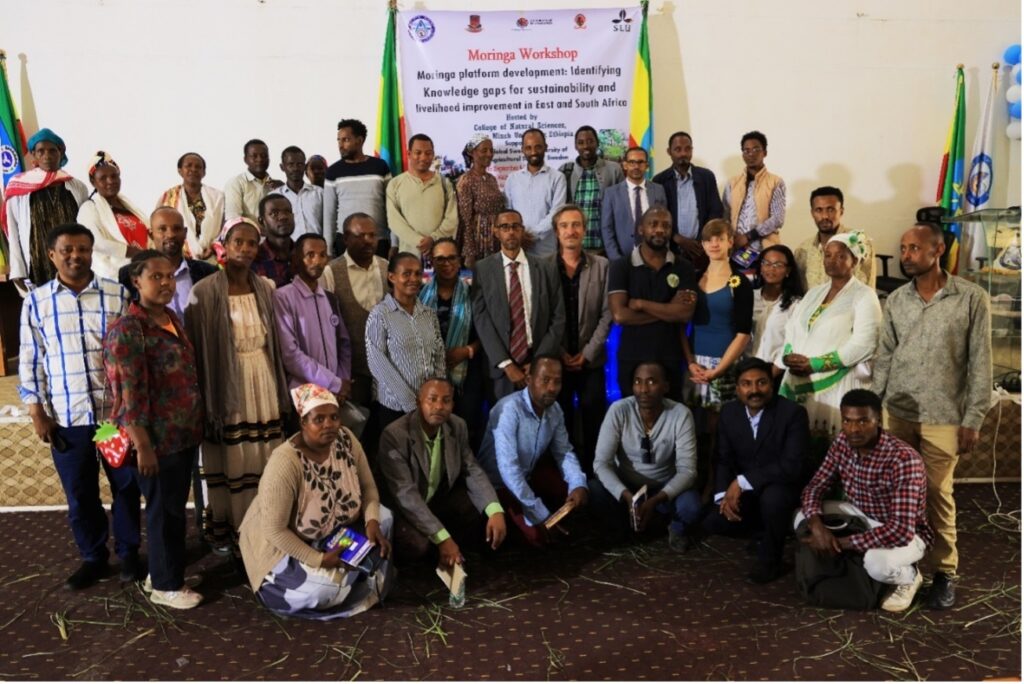
In early September, voices from Ethiopia, Kenya, Zambia, South Africa, and Sweden came together at Arba Minch University in Ethiopia. Farmers, researchers, university authorities, and stakeholders gathered not just to discuss moringa, but to ask a deeper question: How do we unlock the full potential of this Tree of Life?

Inside the workshop halls, farmers shared their challenges: uncertain markets, scarce seedlings, and pests threatening their trees. Researchers listened closely, realizing that science alone cannot shift realities without farmers’ wisdom. Field visits deepened the conversation. Walking between rows of moringa, we saw women pluck leaves for cooking and discussing different aspects of their work. Seeing these practices firsthand transformed abstract ideas into living examples. Knowledge from Kenya, Zambia, South Africa, and Ethiopia debates revolved around knowledge exchange, processing industries, and how to connect farmers to markets. Every context brought a new layer of insight: what works in one context may not in another, but shared learning builds a richer, more adaptable picture.

By the close of the workshop, more than 40 participants left with not just notes and strategies, but also a shared sense of purpose. Moringa is not just a crop; it is a bridge between knowledge systems and communities. We walked away with questions still unanswered, yes, but also with something far more valuable: the determination to answer them together.

Workshop participants discussing moringa cultivation challenges in Ethiopia. Photo credit: Eshika Productions

One tree, many stories: knowledge gaps in moringa cultivation

Across countries, one pattern is clear: knowledge gaps about the moringa tree run deep. Surveys revealed not only challenges but also unexpected insights and striking regional differences. A common thread, however, was clear: education levels are low, and women are the backbone of moringa cultivation, except in Ethiopia, where men predominate and have the longest cultivation history. In Zambia, many farmers were unaware of moringa’s diverse uses or that multiple species can be grown. In Kenya, farmers struggled with a limited understanding of pests and diseases, as well as how soil and climate affect moringa’s growth and productivity.

Despite these differences, the story converges: knowledge is missing where it is most needed. Farmers recognize moringa’s value but lack technical guidance, quality seedlings, reliable markets, and supportive policies to strengthen its cultivation and use. Youth participation is minimal, leaving a gap in innovation and energy that could transform moringa from a household crop into a truly commercial one. Until these gaps are addressed, the so-called miracle tree remains half-awake, full of potential but underutilized.

Telling the story through film

To amplify these voices, a 22-minute documentary was produced by our research team in Ethiopia. It captures farmer testimonies, research insights, and breathtaking visuals, highlighting women’s leadership, knowledge gaps across countries, and the urgent need for youth and policy engagement. Featuring both Moringa oleifera and Moringa stenopetala, the film reminds us of the tree’s diversity and versatility.

From science to policy: the way forward

The Moringa Platform project  revealed a vital truth: science alone is not enough. Research shows moringa’s nutritional value, climate resilience, and its livelihood potential. Communities, too, can share stories of how they grow and use them. But without policy intervention, without governments, agencies, and institutions translating these lessons into practice, moringa’s benefits remain scattered across fields and households.

As one farmer told:

We already know moringa works for our families, but unless it works in policy, it won’t work for our future.”

To transform moringa from an underutilized crop into a driver of nutrition, income, and resilience, the gap between science and policy must close. Moringa can nourish households, empower women, support sustainable livelihoods, and strengthen communities against the challenges of climate change. For this promise to flourish, the knowledge must link with practice and tradition with innovation.

The miracle tree is waiting. What’s holding us back from letting it grow into its full power?

This text is written by Sajeevan Radha Sivarajan, researcher at the Department of Plant Protection Biology at SLU Alnarp. The text is based on his just-concluded project ‘Moringa Platform Development: Identifying Knowledge Gaps for Sustainability and Livelihood Improvement in East and South Africa’ funded by SLU Global. If you are interested in knowing more or discuss, please contact Dr. Sajeevan