
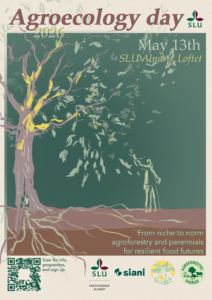
 Agroecology Day is an annual event organized by the Agroecology Masters students at SLU Alnarp. This year’s event aims to bridge the gap between research and practical application of agroecology, with a focus on agroforestry and perennial agriculture. With the theme “From niche to norm: Agroforestry and perennials for resilient food futures”, the event will serve as a platform for researchers, students, practitioners, and industry stakeholders to exchange knowledge, showcase innovative agroecological solutions, and unlock pathways for reconstructing and deepening these practices in real-world settings.
Agroecology day 2026 highlights agroforestry, a term for farming systems where trees and shrubs are mixed with annual or perennial crops and/or livestock.
The specific objectives of this conference are:
- To highlight successful agroecological practices, with a focus on perennial systems, multifunctional landscapes, and agroforestry – demonstrating their essential role for sustainable food production.
- To identify structural lock-ins and other barriers to future adoption of agroforestry, perennial systems, and agroecological practices.
- To facilitate interdisciplinary dialogue between researchers, students, practitioners, and industry stakeholders, with the aim of enhancing practical applications of agroecological perennial solutions and agroforestry.
A description of the impact on the scientific field
Agroecology is a science, movement and practice that applies ecological principles to the study, design and management of agro-ecosystems. Agroecological practices, not least agroforestry and perennial food production, are increasingly recognized as solutions for ensuring food security, biodiversity conservation, and climate resilience. However, scaling these solutions requires collaborative efforts, interdisciplinary approaches, and strong linkages between research institutions, farming communities, interest organisations and industry experts. This conference will facilitate dialogues on perennial practices, challenges, and opportunities for increasing the transformative impact of agroecology by leveraging scientific advancements, policy frameworks, and farmer-led innovations.
Estimated number of participants
100 persons (on-site) and 30 online (from Sweden and abroad, specially students in other Agroecology Program at NMBU, Norway; ISARA, France; Århus University, Denmark and Wageningen Universit
Register for the on-site event here.
To register for online participation, register here. The event will be held on site, with the option to join online for the first half of the day.