
Skip to content
Start of page content below the header

Reimagining artisanal shrimp fishing in Mexico

Photo by: Derek Baumgartner / Unsplash

In the coastal communities of Mexico, artisanal shrimp fishing is far more than an economic activity; it is a way of life grounded in traditional knowledge passed down through generations. The chapter “The Sustainability of Artisanal Shrimp Fishing in Mexico: Challenges and Opportunities”, from the TBTI Global Book “Un Mar de Retos y Oportunidades en la Pesca Artesanal Mexicana” (“A Sea of Challenges and Opportunities in Mexican Artisanal Fishing”), produced by the Small-Scale Fisheries in Latin America Expert Group, connects readers to this living heritage while exploring how bioeconomy and innovation, coupled with traditional knowledge and artisanal practices can support a sustainable future.

Shrimp fishing has shaped communities along Mexico’s Pacific coast for centuries. Before the arrival of the Spanish, Indigenous communities used drag nets and bamboo traps, reflecting deep knowledge of the sea. The twentieth century brought industrial expansion and with it, rising global demand and ecosystem strain. Today, artisanal fishers face declining shrimp stocks, climate change, habitat degradation, and unequal markets.

In a context where resources are shared, but governance is weak, individuals may overexploit them for short-term gain, undermining long-term sustainability. Yet the chapter also suggests that traditional knowledge, combined with innovation and collaborative governance can offer pathways out of this dilemma.

Bioeconomy as a bridge between past and future

Due to the shrinking shrimp populations, transitioning from a linear to a circular economic model could improve the sustainability, efficiency, and profitability of fishing activities and family economies. Linear economy – also known as the take–make–dispose system – extracts natural resources, processes them, and discards waste. Circular bioeconomy, in contrast, seeks to minimize waste, extend product life cycles, and reintegrate by-products into production systems.
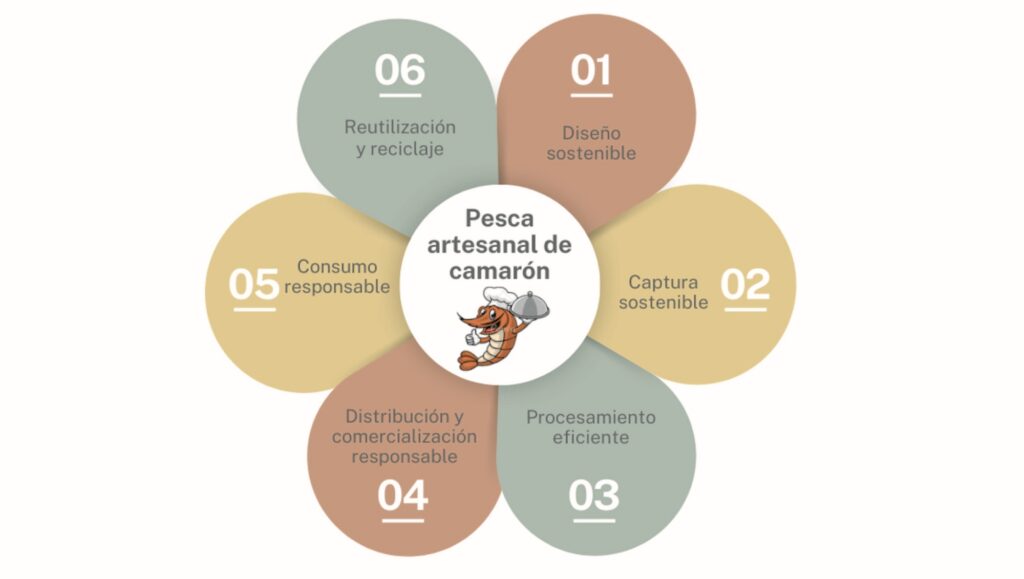
The chapter outlines six basic steps to shift from linear to circular economy: eco-design of fishing gear and packaging where plastic is not an option; sustainable harvesting methods; efficient processing; reuse and recycling of nets and other fisihing gear; consumer education; and valorization of shrimp by-products.

For artisanal shrimp fishers, these steps build on existing natural cycles of reuse and respect for marine ecosystems: fishers have always adapted gear, repaired nets, and repurposed materials.

Value chain innovation through product diversification and cooperatives

Diversification of shrimp-derived products, which involves utilizing all parts of the shrimp, further strengthens resilience. Instead of selling only fresh shrimp, communities can develop value-added products such as marinated shrimp, shrimp pâté, dried shrimp powder, or canned preparations. Heads and shells which are often discarded can be transformed into shrimp meal for animal feed, organic fertilizers, or even bioplastics. This approach not only reduces waste but also opens access to new markets.

One of the most promising strategies is value chain innovation through cooperatives. Artisanal fishers often sell raw shrimp to intermediaries at low prices, taking only a small share of the final market value, leaving fishermen with insufficient income to adequately support their families. By organizing into cooperatives, fishers can collectively manage capture, processing, and marketing. Cooperatives enhance bargaining power, reduce operational costs, and foster shared learning.

Gender equity

Economic justice is central to bioeconomy. Strengthening cooperatives and promoting inclusive governance can empower fisherwomen, ensuring equitable distribution of benefits. This is crucial as unsafe conditions, long hours, and the absence of social protections remain common in artisanal shrimp fishing, underscoring persistent inequality in the sector. Gender discrimination deepens these challenges, as women often face limited access to resources, training, and decision-making power within fishing communities.

At the same time, weak enforcement against illegal and unregulated fishing further destabilizes the sector, undermining long-term sustainability and placing law-abiding fishers at a clear disadvantage. Transparent value chains and traceability systems can increase consumer trust and enable fishers to negotiate fair prices.

Education and intergenerational continuity

Perhaps most importantly, the chapter emphasizes intergenerational continuity. Techniques passed down through generations embody deep ecological knowledge. Beyond its economic role, artisanal fishing fosters social cohesion and a strong sense of belonging, sustaining traditions that unite families and communities.

Sustainability depends on maintaining this continuity. Training programmes on circular economy practices, renewable energy use in processing plants, water recycling systems, and sustainable gear design can enhance environmental and economic outcomes. Extending this education beyond the families and communities of artisanal fishers through partnerships with universities and non-governmental organizations can also support innovation while respecting local knowledge systems.

Small-scale fisheries can become engines of sustainable development

The story of artisanal shrimp fishing in Mexico is ultimately one of resilience. Faced with ecological pressures and market inequalities, coastal communities are exploring bioeconomy pathways that merge innovation with tradition. Circular economy practices, value chain improvements, and product diversification are not abstract concepts; they are practical tools rooted in skillful experience.

By recognizing the cultural significance of artisanal fisheries, the chpater pictures small-scale fisheries as engines of sustainable development. When traditional ecological knowledge converges with bioeconomic innovation not only improves efficiency and profitability, but also promotes environmental sustainability and the well-being of fishing communities.

Small-scale fisheries in Latin America

The SIANI Expert Group Small-scale fisheries in Latin America started in 2025 and is coordinated by TBTI Global. The group raises awareness of the value of small-scale fisheries in Brazil, Colombia, Ecuador, Mexico, and Peru.

Författare