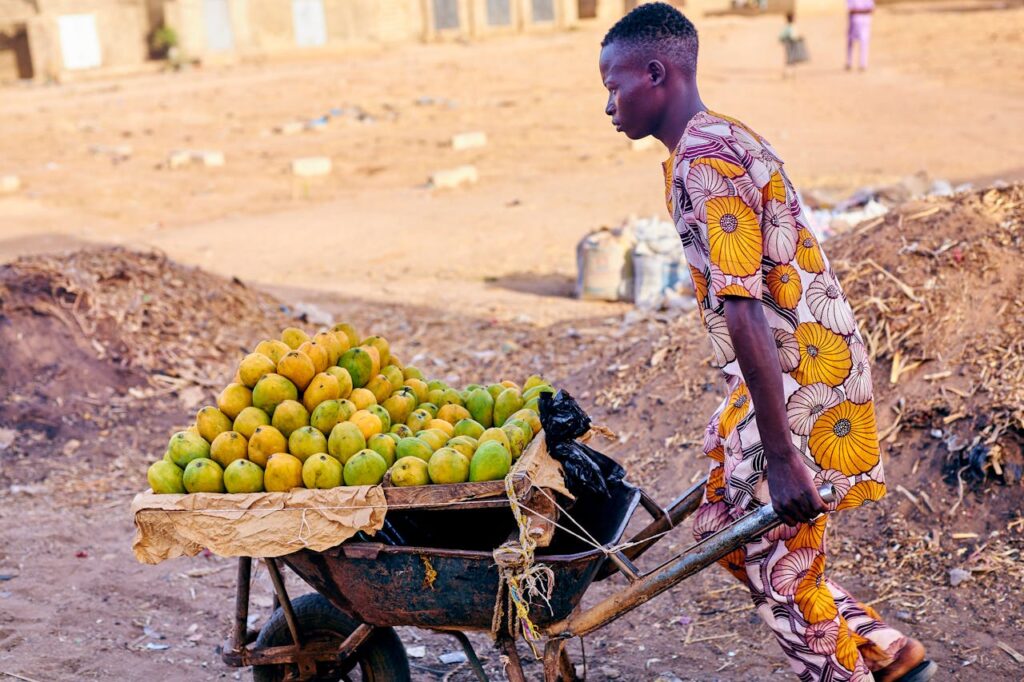
Across Sub-Saharan Africa, smallholder farmers face persistent challenges marked by weak and unequal access to technology and heightened vulnerability to climate and market variations. These pressures underscore the urgency for tailored policies that reflect the complexity of farming systems in the region. Future interventions must reflect the sector’s diversity and be tailored to address inequities between varied smallholder categories.
Africa’s agrarian future
Africa’s countryside, rich in history, heritage, and youthful potential, is in the midst of a quiet revolution not waged with weapons, but with farm tools and bountiful harvests. With over 60% of the rural population dependent on agriculture for livelihood, smallholder farmers- operating on small plots, often with limited capital, rudimentary tools, and facing recurrent climate and market risks are the unlikely frontliners of Africa’s hope for structural economic transformation.
Inspired by the Asian Green Revolution, African policymakers envision millions of small farms and rural communities blossoming into centres of productivity, and prosperity. Continental commitments including the Maputo (2003), Malabo (2014) and recently Kampala (2025) declarations crowned agriculture as the sovereign path out of poverty. In the pursuit of this vision, countries have implemented incentive-based smallholder commercialization programmes such as Ghana’s Planting for Food and Jobs Programme (2017), Prosperity for All Programme in Uganda (2007) and Malawi’s Farm Input Subsidy Programme (2005). But smallholders are also caught in a paradox of enticing policy promises yet practical implementation failures, indicating the need to recalibrate the vision of smallholder-led economic transformation.
The promise and peril of agriculture commercialization
These are among the many outcomes from a recent article by Agnes Andersson and Selorm Kugbega arguing that smallholder agriculture in Africa stands at a critical juncture. On one hand, commercialization has boosted incomes for some farmers, contributing to improvements in rural livelihoods. Findings from Lund University’s Afrint project, which followed nearly 2,500 smallholders across six countries over a decade, show increased agricultural incomes, improved housing standards, and greater market participation.
However, these aggregate improvements conceal widening inequalities. Afrint datasets indicates an expanding gap in land ownership: between 2002 and 2025, the top quartile of smallholders increased their landholdings, while the bottom quartile saw no significant change. Beyond inequalities driven by a powerful rural class of chiefs and wealthy farmers, recent developments point to growing disparities attributed to urban elites. These farmers have greater access to capital, political connections, and markets. They have the capacity to purchase large tracts of land, often at the expense of rural smallholders.
Many poor farmers are left landless and simply viewed as losers in commercialization processes that treat smallholders as a monolith. Yet these farms that are lost also carry heritage, spiritual significance, and serve as vital safety nets across generations.
Added to the inequalities in land asset distribution is a cocktail of gender and generational inequities. Women remain constrained by customary tenure systems that deny them land ownership. Meanwhile youth, often hailed as the future of African agriculture, often struggle to access both land and credit. To complicate matters further, input subsidy programs have too often become vehicles of political patronage, diverted to wealthier farmers or sold across borders. Lacking clear exit strategies, these subsides risk creating long-term fiscal burdens without the structural change the sector urgently needs.
Way forward
What Africa’s smallholders need is not another wave of well-intentioned, poorly implemented commercialization programmes. They need a reimagined approach to agriculture that provides tailored support, reflecting smallholder diversity and moving beyond generic subsidies towards investments in irrigation, transport, agro-processing, and locally relevant support. It also requires using agriculture less as a political bargaining chip for short term electioneering gains.
Africa’s smallholders are not passive beneficiaries; they are active economic agents navigating uncertainty with limited means. But unless policies and implementation practices align more closely with their lived realities, and unless the systemic inequalities within the smallholder sector are addressed, the dream of smallholder-led transformation will remain elusive.