
The agricultural sector in Africa holds tremendous potential to address poverty and improve livelihoods, health, economic development, and environmental sustainability. Yet African agricultural investment is shaped by a complex mix of demographic, ecological, political, and market pressures. The lack of cohesion in the definition of “sustainable agriculture” hinders systemic approaches, stressed David Laborde, Director of the Agrifood Economics Division, FAO.
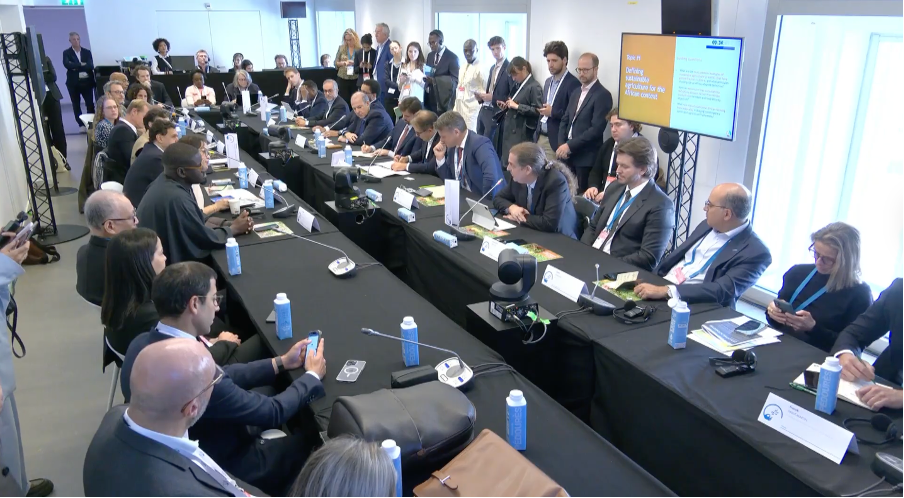
In this context, as part of the Paris Peace Forum, Atlas organised a roundtable to bridge the gap between African agri-food systems potential and the current under-investment.
Finding common ground on sustainable agriculture in Africa
A central theme of the discussion was the urgent need to define “sustainable agriculture” in a way that is both holistic and tailored to Africa’s unique realities.
The conversation began by confronting a fundamental challenge: Africa is trapped in a “vicious cycle of poverty and land degradation”, asserted Leonardus Vergütz, Chief Science Officer, OCP Nutricrops. Its naturally poor and infertile tropical soils, combined with limited access to inputs, lead to low yields. This, in return, forces farmers to expand into new land, driving further deforestation and degradation. The solution, therefore, is not to produce less, but to produce more on existing land. As evidenced, applying the right nutrients, like phosphorus, and increasing watering not only boosts yields but also helps sequester carbon underground, creating a virtuous cycle of improved soil health and climate mitigation.
“We can transform African agriculture to make it a powerhouse of sustainability and to help us fight climate change” – Leonardus Vergütz
A broad consensus has emerged about the need to move beyond a narrow environmental focus to embrace a triple-win framework integrating productivity, resilience, and social inclusion while ensuring environmental benefits. Productivity would close the yield gap through adapted inputs, improved seeds, irrigation, and rainfed agriculture. Resilience would build climate-smart systems through regenerative practices and healthier soil. Inclusion would ensure that economic benefits reach smallholder farmers, provide a living income and attract youth and women into the sector.
It was agreed that the definition of sustainable agriculture must be African-led, co-created with national governments, local research institutions, and farmers themselves, moving away from externally imposed “copy-paste” solutions.
De-risking and financing the transition
While African agri-food systems hold the key to achieving half of the Sustainable Development Goal gaps, they receive less than 5% of global collective resources. The Atlas initiative’s call to double investments by 2030 was a central pillar of the discussion, leading to an exploration of financing mechanisms.
A major adoption barrier is the transition cost for farmers moving to regenerative practices. Although these practices are beneficial in the long term, the initial investment is often unaffordable for smallholders, explained Ismahane Elouafi, Executive Managing Director, Consultative Group for International Agricultural Research (CGIAR). This highlights the need for cost-effective, innovative financing models that blend public and private capital:
- Concessional finance is critical in a context of high national debt. The Green Climate Fund (GCF) provides grants and concessional loans to de-risk projects. GCF allocates $2.5 billion to agriculture and food security, emphasising that concessionality is key to avoiding exacerbating debt burdens.
- Blended finance and de-risking: Platforms like the MAVA demonstrate how public development banks and private companies can collaborate. Using yield-based insurance from companies like Pula mitigates production risk, thereby unlocking credit from local banks for smallholders.
- Carbon finance can create a new revenue stream that rewards sustainable practices. Integrating African farmers into carbon markets requires robust baselines and monitoring systems to quantify and verify carbon sequestration.
Public investment also plays a pivotal role in creating an enabling environment. Funding for public goods such as digital soil maps, national extension services, and policy consistency is foundational for attracting private sector investment at scale.
The enabling environment: data, simplified metrics, and national ownership
Effective and scalable investment requires a supportive ecosystem.
The lack of reliable, and localised data remains a critical bottleneck. Nationally owned, open-source data systems can provide a shared evidence base for all actors, avoid duplicates and build interoperable tools. Access to data demonstrating impacts helps target investments, provide insurance and measure carbon sequestration.
There was also encouragement for harmonised and simplified indicators in data-scarce environments. The push is for a tractable, understandable and transparent set of key performance indicators (KPIs) focused on core outcomes like yield, soil organic carbon, and farmer income. This simplicity is vital for clarity, attracting investment, and ensuring farmers can relate and engage with the metrics.
The principle of country ownership is also paramount. The GCF’s model of “country platforms”, where national governments define their own project pipelines and choose their partners, was highlighted as best practice. However, this approach requires parallel investment in strengthening national institutions to ensure that local actors, not just international partners, drive the agenda and that benefits are equitably shared.
By sustaining this collaborative momentum and leveraging platforms like Atlas, stakeholders can unlock the transformative potential of sustainable agricultural investment in Africa towards food security, climate resilience, and inclusive growth.
Written by David Mingasson, SIANI reporter