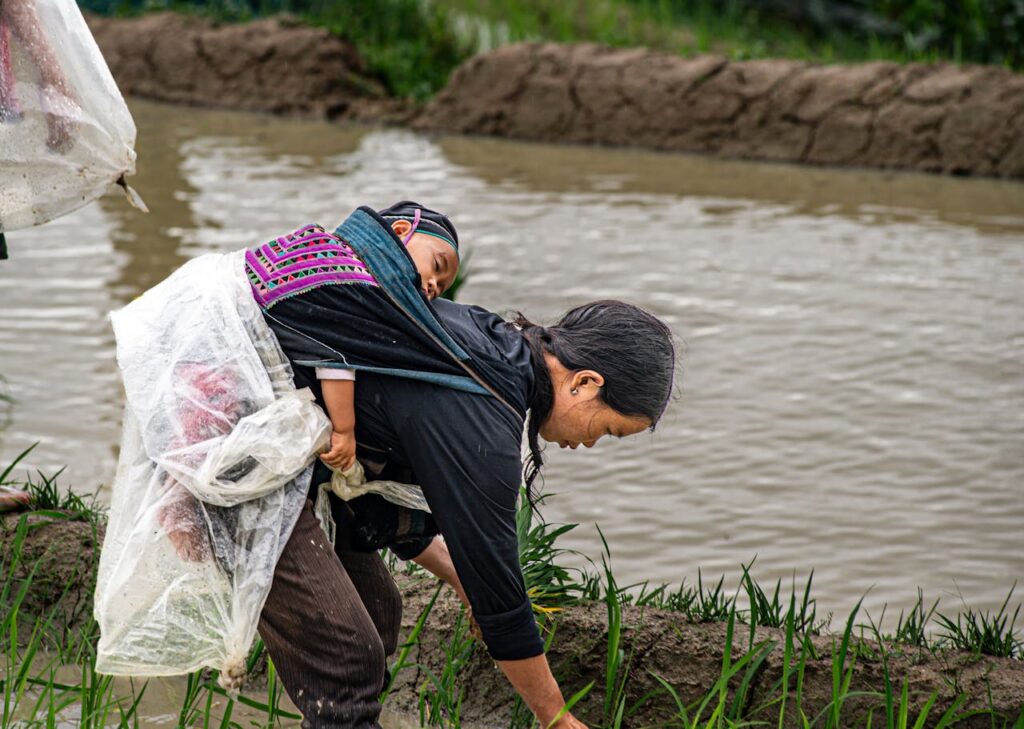
Being a woman in the world today still means facing systemic inequality. Worldwide, women hold only 64 percent of the legal rights granted to men, according to UN Women. This gap is not accidental; it is the result of deeply entrenched social norms and discriminatory laws that continue to limit women’s opportunities and freedoms.
Despite a discouraging political climate and the deeply rooted sexism, the progress made by generations of women cannot be taken for granted. These hard-won rights must be actively defended. It’s crucial that we safeguard the advancements in women’s rights, as these rights ultimately uplift us all: our grandmothers, mothers and daughters, neighbours and colleagues, teachers and doctors, and the women who grow our food.
Women cultivating for all for less
Globally, women make up more than 43 percent of the agricultural workforce in developing countries, increasing to 60 per cent in low-income countries. Despite this, they face discrimination in terms of land and livestock ownership, equal pay, participation in decision-making processes, and access to credit and financial services, all essential for their productivity. For instance, less than 15 percent of all landholders are women.
Research suggests that securing land rights for women can lead to better outcomes, impacting food security, reducing gender-based violence, and improving children’s education, health, and food security.
The Agriculture Organization of the United Nations (FAO)’s report The Status of Women in Agrifood Systemsprovides a detailed overview of women’s roles and conditions in the sector. Women working in agrifood systems are more likely to be poorly paid and employed in part-time or informal jobs. The COVID-19 pandemic and subsequent economic crises further exacerbated these inequalities. Globally, in the first year of the pandemic, 22 percentage of women lost their jobs in the off-farm segment of agrifood systems, compared with just 2 percentage of men. According to FAO estimates, closing gender gaps in farm productivity and wages across agrifood systems could reduce global food insecurity by 2%, lifting 45 million people out of food insecurity.
The role of gender in economics
Women also bear most unpaid care work worldwide. In every country, women perform around three-quarters of unpaid care work, spending on average 3.2 times more time on it than men. Nowhere do women and men share this work equally. As a result, women are persistently time-poor and place-bound, limiting their participation in the labour market.
Women play a vital role in agriculture and have strong potential to drive positive change for global food security. However, their working conditions and roles are often worse than those of men. As highlighted by Dr. Lauren Phillips, and Tacko Ndiaye, in a 2023 interview on The Status of Women in Agrifood Systems, women and girls are frequently concentrated in irregular, informal, part-time, low-skilled, and labour-intensive jobs.
Women and agricultural productivity
In this context, the Voluntary Guidelines on Gender Equality and Women’s and Girls’ Empowerment in the Context of Food Security and Nutrition provide concrete policy guidance to advance gender justice, empowerment, and leadership in national food security efforts. While the Guidelines acknowledge unpaid care and domestic work alongside women’s employment, they fall short, for instance, in addressing a persistent challenge related to access to productive resources, often referred to as “women’s crops.” Men and women often cultivate different crops and/or different varieties, shaped by socially assigned roles. As Sabine Guendel explained, cash and export crops are frequently regarded as ”men’s crops” and subsistence crops as ”women’s crops”. The conventional narrative suggests women grow food for household consumption while men farm for income. Yet these roles shift in response to economic opportunity: when men migrate, women take on traditionally male tasks, and when crops become profitable, men frequently enter activities once dominated by women.
Adding another layer to these challenges, climate change affects countries, communities, and individuals unequally due to deeply rooted historical and social processes of exclusion and marginalisation. As highlighted in the FAO report The Unjust Climate, climate change not only exposes existing social and economic inequalities but also reinforces and deepens them.
Transformative approach
Regardless of the believes or social norms and structural barriers, no justification exists for perpetuating the denial to women’s full access to fundamental human rights. Ensuring women’s equal participation in and benefits from technology, land and natural resources, financial services, education, entrepreneurship, and policymaking is essential. Access to timely and accurate information is critical, yet women are too often excluded.
Agricultural research, development, and extension services remain largely male-dominated, frequently overlooking women’s roles and priorities, while social norms and cultural practices continue to restrict women’s participation in development initiatives. As Laura del Duca reminded us: “because patriarchy is systemic, achieving gender equality requires systemic solutions.”
Gender-transformative approaches, capable of shifting harmful norms, redistributing power, and engaging men and boys, are both cost-effective and high-impact. True equality in food systems and beyond will only be possible when women are recognised not merely as beneficiaries, but as leaders and decision-makers.
In this regard, the Joint Programme on Gender Transformative Approaches offers a robust Theory of Change for gender transformative programming in food security, nutrition and sustainable agriculture. Grounded in the socio-ecological model, this framework recognises that sustainable norm change must occur simultaneously at individual, household, community, organizational and policy levels. It emphasizes addressing women’s practical needs and their strategic interests, including voice, leadership and decision-making power. By acting across the three domains of empowerment: agency, relations and structures, the approach seeks to transform discriminatory norms, unequal power relations and gender-blind institutions. Importantly, it engages men and boys as allies in reshaping masculinities and promoting shared responsibility. Evidence from country experiences such as Ecuador, demonstrates that identifying local root causes of inequality and tailoring interventions accordingly can generate lasting improvements in women’s empowerment while contributing directly to the achievement of SDG 2: Zero Hunger.