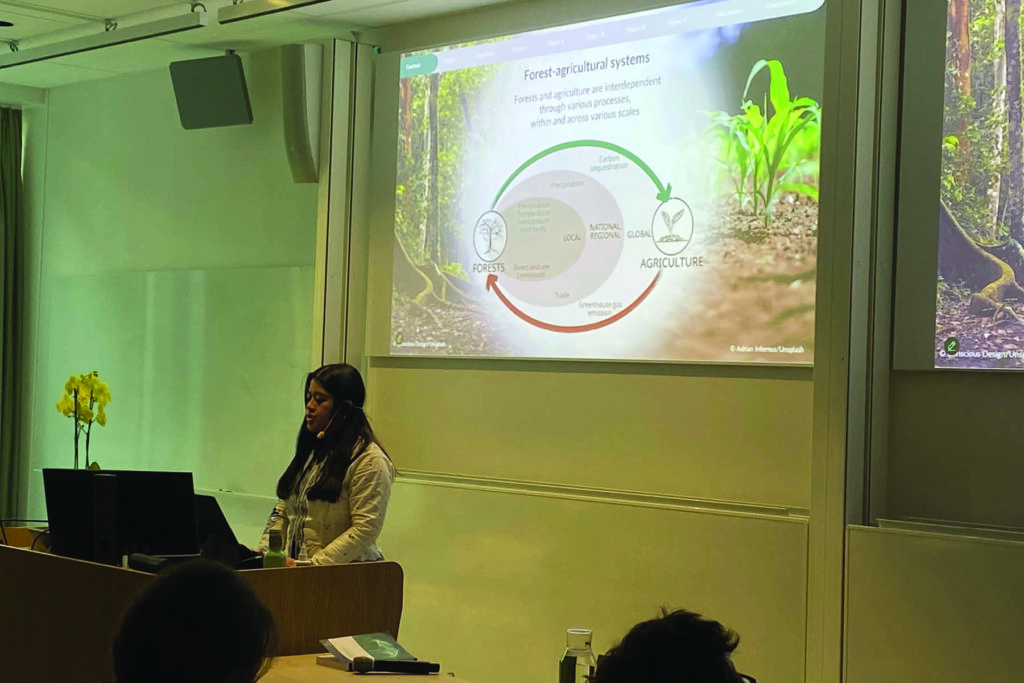
Research by Focali member Agnes Pranindita, defended, at the Stockholm Resilience Centre her PhD thesis “Moisture recycling in forest-agricultural systems: An interdisciplinary view within and across scales” that highlights how moisture recycling, the movement of evaporated water through the atmosphere before falling again as precipitation, connects forests, agriculture, and human livelihoods across regions and sectors. Understanding how moisture flows intersect with the trade of agricultural commodities, as well as agricultural livelihoods, provides a new perspective on the interdependence of ecosystems, economies, and societies.
Moisture recycling is a hydrological process in which water evaporates from land or oceans, travels through the atmosphere, and later returns as rainfall elsewhere. Forests play an important role in this cycle. Through evaporation and plant transpiration, forests release large volumes of water vapor into the atmosphere, which can later fall as precipitation in distant agricultural regions.
This process creates a form of atmospheric connectivity between landscapes, revealing that forests function as biodiversity reservoirs and carbon sinks, and also as water regulators for agriculture. As a result, changes in forest cover can have cascading effects on crop production, food supply, and rural livelihoods far from the original site of deforestation.
Recent research demonstrates the magnitude of this dependence. Pranindita’s study published in Nature Water shows that croplands in 155 countries depend on moisture originating from forests in other countries for up to 40 percent of their annual precipitation. Such findings emphasize that forests play a vital yet often invisible role in supporting global agriculture.
Moisture recycling also intersects with the global trade of agricultural commodities. Modern food systems rely heavily on international trade networks. However, these supply chains are indirectly influenced by atmospheric moisture flows linking forests and agricultural areas across borders.
For instance, crop production in one country may depend partly on rainfall generated by forests in another. When agricultural commodities produced in that region are exported to a third country, the trade network effectively transmits the ecological influence of those forests across the global food system.
One example in Pranindita’s research case involves agricultural exports from Ukraine. Crop yields there depend partly on moisture flows originating from forests in Russia. If those forests were degraded, precipitation patterns in Ukrainian farmland could shift, potentially affecting agricultural production and exports to global markets.