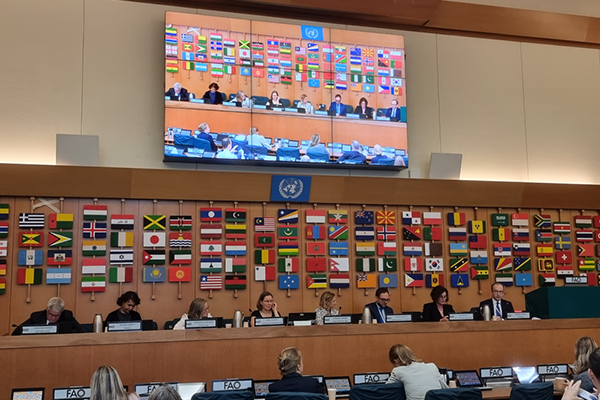
The 53rd Session of the Committee on World Food Security (CFS 53) will take place from 20 to 24 October 2025 in a hybrid format at FAO Headquarters in Rome, offering opportunities for both in-person and online participation. CFS is the UN’s foremost platform for policy dialogue on food security and nutrition, bringing together governments, civil society, researchers, private sector actors, and UN agencies in one inclusive forum.
This year’s CFS carries the theme ”Making a Difference in Food Security and Nutrition”, reflecting the Committee’s ambition to influence and improve global food systems. The agenda includes the launch of the State of Food Security and Nutrition in the World (SOFI) 2025 report, regional dialogues, a panel on Collaborative Governance, and discussions on responsible investment and financing, as well as the intersection of climate, biodiversity, and the right to food.
SIANI’s side events
We are pleased to announce that SIANI will co-host two side events at CFS 53, aligning with the overall agenda of fostering diversity, collaboration, and systemic change.
SE10: Looping into tomorrow’s food systems – Innovative circular bioeconomy as a path to building resilient food systems
- Time and date: Tuesday 21 October, 13.30-14.45
- Location: Online (Zoom) and the Ethiopia room, FAO Headquarters
- Registration for online participation can be found here.
Abstract: While global food security is lagging behind, organic waste from households and food production cause major water and soil pollution and GHG emissions, not the least in urban and peri-urban areas. In parallel, the dependency of imported fossil fuel-based fertilizers, feed and food is growing, while international trade is volatile. To link these systems, new behaviours need to be encouraged, and responsibilities reshaped. By separating organic waste and by-products already at the source, it is possible to develop decentralized solutions for waste streams, which are efficiently used as nutritious high-value resources for fertilizers, bioenergy, feed and food. This event will show innovative ways to harness available resources into food value chains, contributing to nutritious and sustainable food systems, and increasing communities’ resilience and independence. It will explore how disconnected systems can be linked into a circular bioeconomy for sustainable and resilient food security.
SE13: Investing in the future: Building partnerships and strengthening financing for healthier School Meals Programmes
- Time and date: Wednesday 22 October, 8.30-9.45
- Location: Online (Zoom) and the Philippines room, FAO Headquarters
- Registration for online participation can be found here.
Abstract: Recent estimates from SOFI 2025 show global hunger declined from 8.5% in 2023 to 8.2% in 2024, mainly due to progress in Asia and South America, while it continues to rise in Africa and Western Asia. Food insecurity also decreased gradually, reaching 28% of the global population in 2024, with improvements in Latin America, the Caribbean, and Asia, but worsening trends in Africa. The cost of a healthy diet rose by 3.7% in 2024, reaching 4.46 PPP dollars per person per day. Despite this increase, the number of people unable to afford such a diet dropped to 2.6 billion, with notable reductions in Asia and slight decreases in LAC, Northern America, Europe, and Oceania. Africa, however, saw increases in both the share and number of people affected. Obesity continues to rise worldwide, affecting 15.8% of adults in 2022, up from 12.1% in 2012. LAC has the highest prevalence at and the steepest increase. Child overweight remained stable globally at 5.5% in 2024, though LAC shows the highest levels and increases. School Meals Programmes are key strategies to address food insecurity and malnutrition, especially among school-age children and adolescents. Despite global investments of nearly USD 50 billion, challenges persist. Sustainable financing, knowledge and locally engaged partnerships are essential to ensure quality, inclusion, equity and long-term impact. For instance, the Sustainable School Feeding Network (RAES), led by Brazil-FAO cooperation, supports 18 LAC countries to enhance their SFP through dialogue, policy development, nutrition standards and public procurement from family farming. While financing is one key component, knowledge and understanding of the enabling environment, nutrition, local food preferences and local partnership are also pivotal for scaling up the programmes. The School Meals Coalition, with over 100 members, fosters global collaboration to ensure every child receives a healthy school meal by 2030. Its Sustainable Financing Initiative builds evidence and provides technical assistance to boost domestic investment. By sharing best practices with regards to financing and collaboration as well as discussing enabling environments with a child-centered approach, the event will highlight how school meals can become a driver of agrifood resilience, and access to affordable healthy diets.