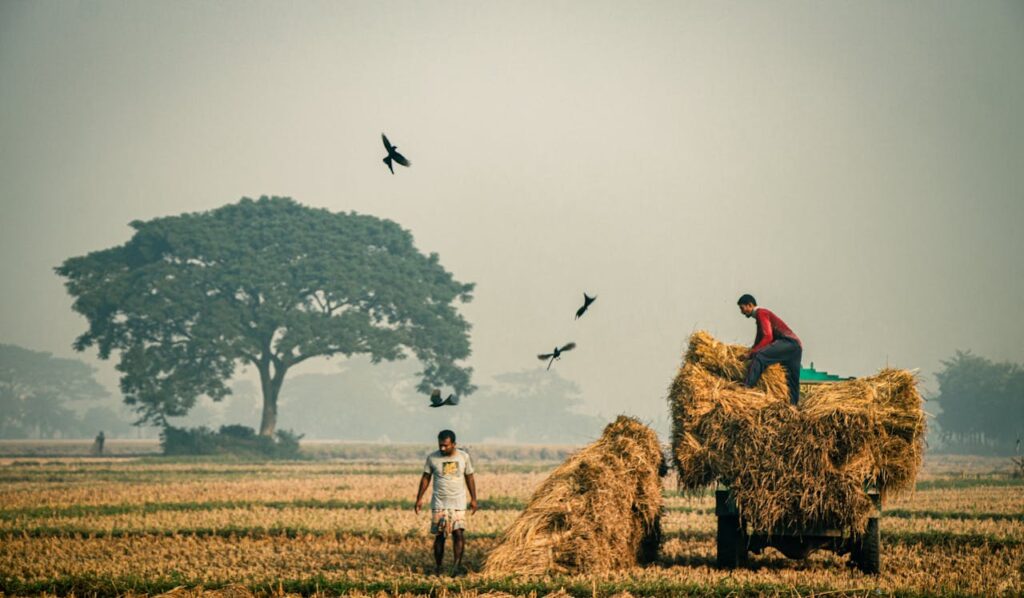
Agriculture has been embedded in the climate agreement, but often loosely
Food systems contribute significantly to climate change through land-use change, unsustainable farming practices, processing, transport, consumption, and waste disposal. At the production level, methane emissions from livestock and rice cultivation, nitrous oxide from fertilizers, and carbon losses from soil degradation and deforestation together represent roughly one-fifth of global anthropogenic emissions. Despite this, agriculture remained peripheral in climate change agenda. This began to shift with the UAE Declaration on Sustainable Agriculture, Resilient Food Systems, and Climate Action, endorsed by more than 150 countries at COP28. This political breakthrough reflects the cumulative outcomes of numerous agriculture-related and food-system initiatives launched since the Paris Agreement in 2015 such as the 4/1000 Initiative: Soils for Food Security and Climate, which boosts soil carbon sequestration to enhance soil fertility and reinforce agricultural resilience and the SAVE FOOD Global Initiative on Food Loss and Waste Reduction, designed to reduce food loss and waste across the entire value chain.
Efforts have focused on adaptation and less on mitigation
Over the past decade, many countries have acknowledged the role of agriculture in meeting their nationally determined contributions (NDCs). Yet this has not often translated into measurable transformation. Implementation has focused on adaptation- helping farmers cope with erratic rainfall, droughts and floods while models for leveraging agriculture for climate mitigation purposes are lacking and often focused on agroforestry systems and related tree-based carbon storage. Some mitigation attempts have been unsuccessful such as integrating fast-growing trees in smallholder farms that has led to food security concerns as trees take over farmland and food crop production becomes less viable. Thankfully, the scientific evidence is emerging on how integrated approaches can deliver both adaptation and mitigation benefits without compromising livelihoods. The evidence concerns actions such as diversified cropping, agroforestry, zero tillage, nutrient cycling, integrated pest management, precision agriculture and biochar application.
Despite these advances, agriculture remains underrepresented in stock-taking moments. Other sectors, including energy and transport, benefit from more transparent and easier emission calculation and forecasting pathways. In contrast, agricultural contributions are either considered slow, such as soil carbon sequestration and ecosystem restoration that unfold over decades-,or volatile and easily changeable by farmers threatened by livelihood risks.
Future entry points
Climate action in the next decade must rigorously account for the contributions of millions of smallholder farmers, particularly their ongoing transition toward more sustainable practices. Stronger links are needed between high-level policy commitments and the operational realities of implementation on the ground. Central to this alignment is developing accessible and reliable systems capable of tracking the relatively slow but critical processes of soil carbon sequestration and ecosystem restoration. A key step is to include clear, measurable targets for methane, nitrous oxide, and carbon emissions in NDCs, and connect these targets to robust mitigation strategies tailored to the diversity of farming systems. Developing robust monitoring frameworks will require investments in subregional agricultural datasets to improve transparency and accountability. However, developing these monitoring systems is not only a technical challenge, but also a political one as some countries resist real-time data disclosure, due to fears of economic or geopolitical repercussions.
Equally crucial is the realignment of financial incentives. Agricultural subsidies in many countries continue to incentivize harmful practices. Redirecting a portion of these funds toward climate-smart practices could yield climate and ecological benefits. The EU’s Common Agricultural Policy (CAP, 2023–2027 programming period) offers a good example of innovative financing schemes that seek to realign subsidies with climate goals. It allocates 25 per cent of direct payments to eco schemes to incentivize nature-friendly practices, supporting adaptation and mitigation efforts.
Recent estimates show that only 7.2 per cent of global climate finance is directed toward agrifood systems, an increase of 3.6 per cent in 2020, but still far below what is needed. Yet, agriculture (including forestry and other land uses) which is the world’s second-largest emitter after energy, receives only 8.3 per cent of the USD 1.1 trillion required annually to align the sector with global climate goals. Paradoxically, 94 per cent of countries identify agrifood system interventions as central to climate adaptation, and 91 per cent include them in mitigation strategies within their NDCs. Addressing this gap requires a coherent framework and a well-funded implementation strategy that translates political commitments into operational pathways for food-system transformation. Such a strategy would support the mobilization of dedicated resources for interventions that generate net-positive climate outcomes, while ensuring fair and equitable transitions, that recognize and compensate the efforts of diverse stakeholders, including millions of smallholders who can be key change agents in managing the climate crisis.
Private sustainability schemes offer a third critical entry point. Many already incorporate climate concerns into their standards and certification processes. However, these initiatives remain largely uncoordinated, limiting their collective potential to show contributions to national climate goals. While certification schemes promote practices that reduce emissions, enhance soil carbon, prevent deforestation, and build farmer resilience, their impact remains diluted by inconsistent criteria and weak interoperability. A more integrated architecture where schemes harmonize core climate metrics, share monitoring data, and collectively incentivize high-impact actions- could scale their effectiveness. This could improve smallholder capacity to make GHG mitigation claims and access to climate funds while also enabling governments to better streamline the incorporation of verifiable supply-chain data into national climate strategies and NDCs.
Keeping the momentum
As we look toward the next decade, the growing recognition of food systems as central to the climate agenda must be further intensified. Advancing this agenda will broaden and deepen the global climate agenda, which has evolved beyond a narrow focus on emission reduction. Today, climate action is fundamentally about aligning the global economy through coordinated, multisectoral efforts that both limit global warming and strengthen resilience across societies and ecosystems. Agriculture, long overlooked, now stands as a crucial pillar of this transformation. Sustaining the momentum built since 2015 will be essential for ensuring that the world’s food systems contribute meaningfully to a livable, climate-resilient future.