
The CFS (Committee on World Food Security) “Uptake Stocktaking Exercise” refers to the evaluation and dialogue processes designed to track how effectively Member States and stakeholders implement CFS policy guidelines into national food systems and nutrition strategies
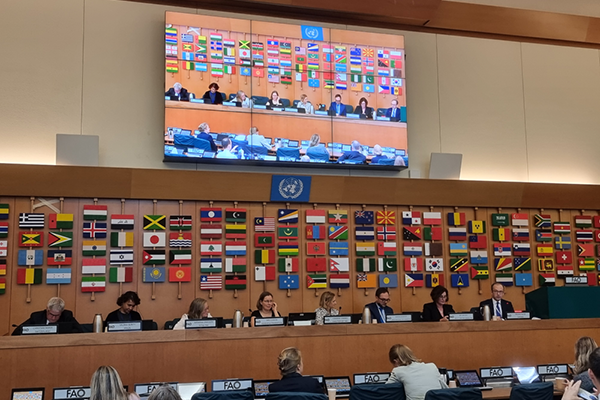
At its 52nd Plenary Session held in October 2024, the Committee endorsed the Action Plan to Strengthen the Uptake of CFS Policy Products which presents a roadmap with actions for different CFS stakeholders that are responsible and accountable for promoting the uptake of CFS policy products at all levels towards the progressive realization of the right to adequate food.
The Action Plan includes tiered actions to be addressed by different CFS stakeholders, with proposed activities to be undertaken to strengthen the usefulness and ownership of CFS policy products, promote awareness and their use among intended users, and to advance cross-cutting areas that refer to the ability to raise resources, monitor and evaluate activities and provide a platform for discussions for interested stakeholders.
More specifically, Action 3.1 recommends developing a Digital Repository that provides a consolidated overview of CFS uptake activities, with information on the use of CFS policy products made at global, regional, national and local levels.
As agreed by the CFS Bureau, in consultation with its Advisory Group, the preparation of the Digital Repository will be informed by the results of an Uptake Stocktaking Exercise which was designed to collect the required information from CFS stakeholders.
In this regard, we warmly encourage CFS stakeholders to submit the outcomes of their uptake efforts by using the Submission Template.
This Uptake Stocktaking Exercise is open to all CFS stakeholders, including Member Countries, UN agencies, civil society and non-governmental organizations, farmers’ organizations, private sector and philanthropic foundations, international financial and agricultural research institutions, academic institutions and any other relevant actor.
Submissions may cover any example of uptake and do not need to be limited to specific policy products or timeframes. Contributions showcasing the use of multiple policy products are particularly encouraged.
The Submission Template is structured around three main sections:
- Description of how the concepts and recommendations included in CFS policy products have been applied in specific contexts and how they contributed to changes in policies, institutions and capacities, including the diversity of stakeholders involved in the process;
- Inclusion of any type of resources and tools that were developed to support the uptake of specific CFS policy products, such as guidance materials, handbooks, technical guides, policy dialogues, webinars, trainings, e-learning courses and analytical frameworks;
- Presentation of examples of alignment between national policies and specific CFS policy products, regardless of whether these policies were adopted before or after the relevant CFS product in order to showcase actions taken and identify opportunities for further engagement and potential entry points for the uptake of CFS policy products.
An illustrative example of a submission – showing the type of information expected in each of the three sections – is available in the template to guide the work of CFS stakeholders.
As mentioned, the inputs received will feed the preparation of the CFS Digital Repository which will be added to the CFS website.
In order to give enough time for CFS stakeholders to collect inputs within their constituencies, the deadline for the submission of the template is 9 November 2026.
CFS Stakeholders are warmly encouraged to disseminate the Submission Template as wide as possible to ensure that all relevant stakeholders at national, regional and global levels are engaged in the process.